
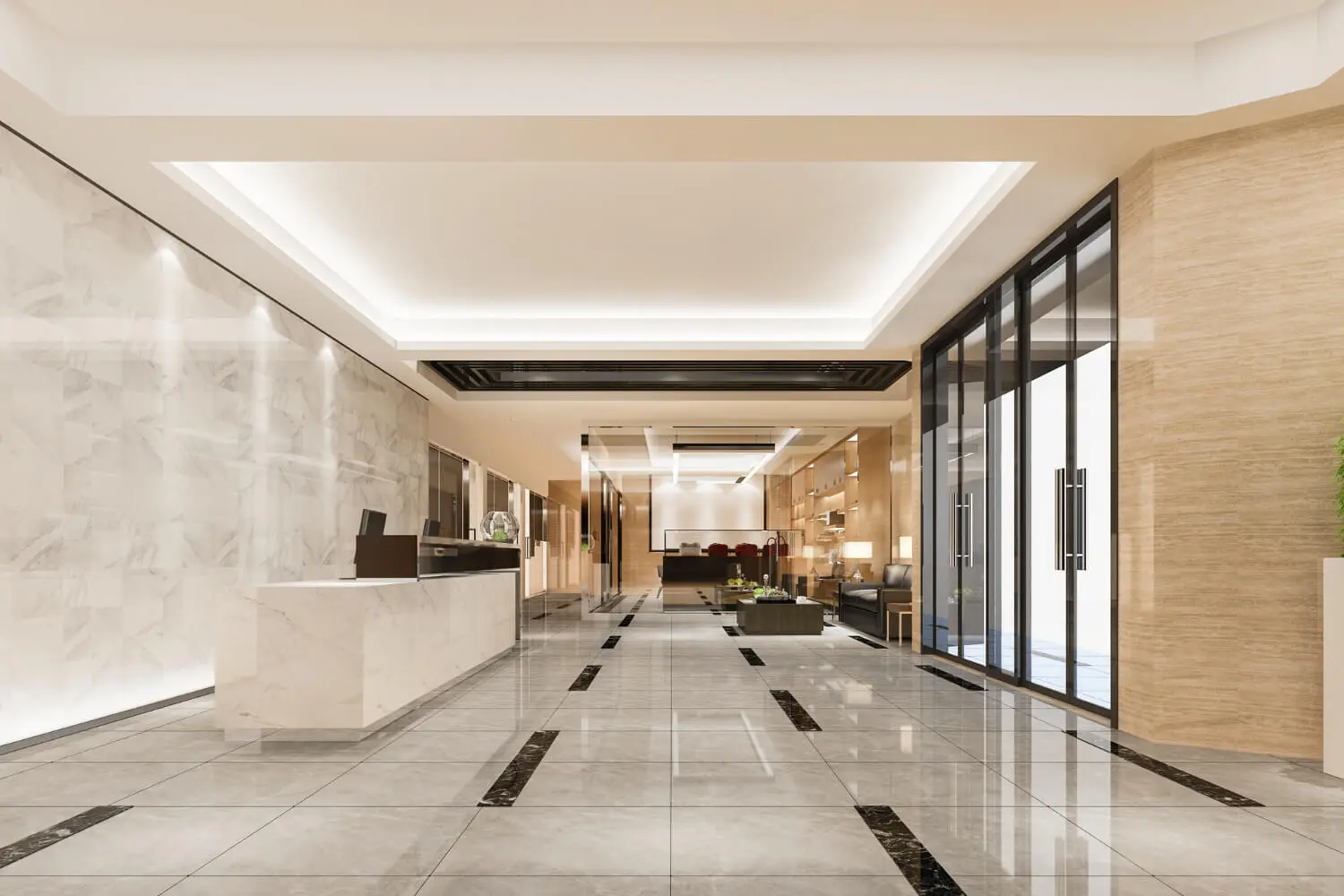
The short answer is that gypsum board is usually the more predictable choice for a clean, modern false ceiling in a dry living room, bedroom or office. It is factory-made, installed through a defined metal-frame system and finished with taped joints. POP is more useful when the design needs tight curves, decorative mouldings, cornices or sculpted details that are difficult to create from flat boards.
That does not make one material universally better. A poorly spaced gypsum framework can sag or crack at joints, while an incorrectly mixed or hurried POP ceiling can develop shrinkage cracks and uneven surfaces. The final result depends on the complete system: slab condition, hanger and channel specification, board or mesh, joints, electrical coordination, moisture control, workmanship and maintenance access. A Gypsum vs POP Ceiling decision should therefore compare the full assembly, not only the visible finish.
Choose gypsum board for faster, cleaner and more consistent work with straight lines and contemporary details. Choose POP for handcrafted curves, mouldings and seamless decorative forms. For many Lucknow homes, the practical answer is a hybrid: a gypsum-board base with limited POP features where genuine shaping is required.
What Is Gypsum Board?
Gypsum board, also called gypsum plasterboard or drywall board, is a factory-produced panel with a gypsum core held between surface liners. For a false ceiling, boards are screwed to a suspended galvanized-steel framework fixed below the structural slab. The installer tapes the joints, applies the specified jointing compound, sands the surface, primes it and finishes it with compatible paint.
Standard boards suit normal dry interiors. Manufacturers also offer boards designed for higher moisture exposure, fire-performance systems, acoustics or other specialist needs. These labels are not interchangeable, and the board alone does not create a tested performance rating. Framework, fasteners, board layers, joint treatment, perimeter details and installation method must all match the intended system.
Gypsum board is not the same as a solid structural ceiling. It is a finish component within a suspended assembly. Fans, chandeliers, heavy pendants, AC ducts and other significant loads need independent support from the slab or a designed structural provision; they should not simply hang from the board.
What Is POP (Plaster of Paris)?
Plaster of Paris is a fine white powder produced by heating gypsum and removing part of its chemically combined water. When mixed with clean water, it forms a workable paste that sets comparatively quickly. In ceiling work, POP may be applied over a suitable mesh and framework, used to finish a prepared base, or cast into cornices, ceiling roses, mouldings and decorative elements.
POP is a wet-applied craft process. The installer controls the water ratio, batch size, thickness, shaping and surface level at the site. This flexibility is its main attraction, but it also makes workmanship more influential. Incorrect mixing, excessive thickness, weak reinforcement, rushed finishing or movement at the supporting frame can lead to waves, hollow areas and cracks.
Because both products originate from gypsum, the comparison is not gypsum versus a completely unrelated material. It is mainly factory-made gypsum-board dry construction versus site-mixed POP wet construction. That distinction explains most differences in speed, consistency, design freedom and quality control.
Read also: Complete Guide to False Ceiling Designs
Gypsum Board vs POP: Basic Differences
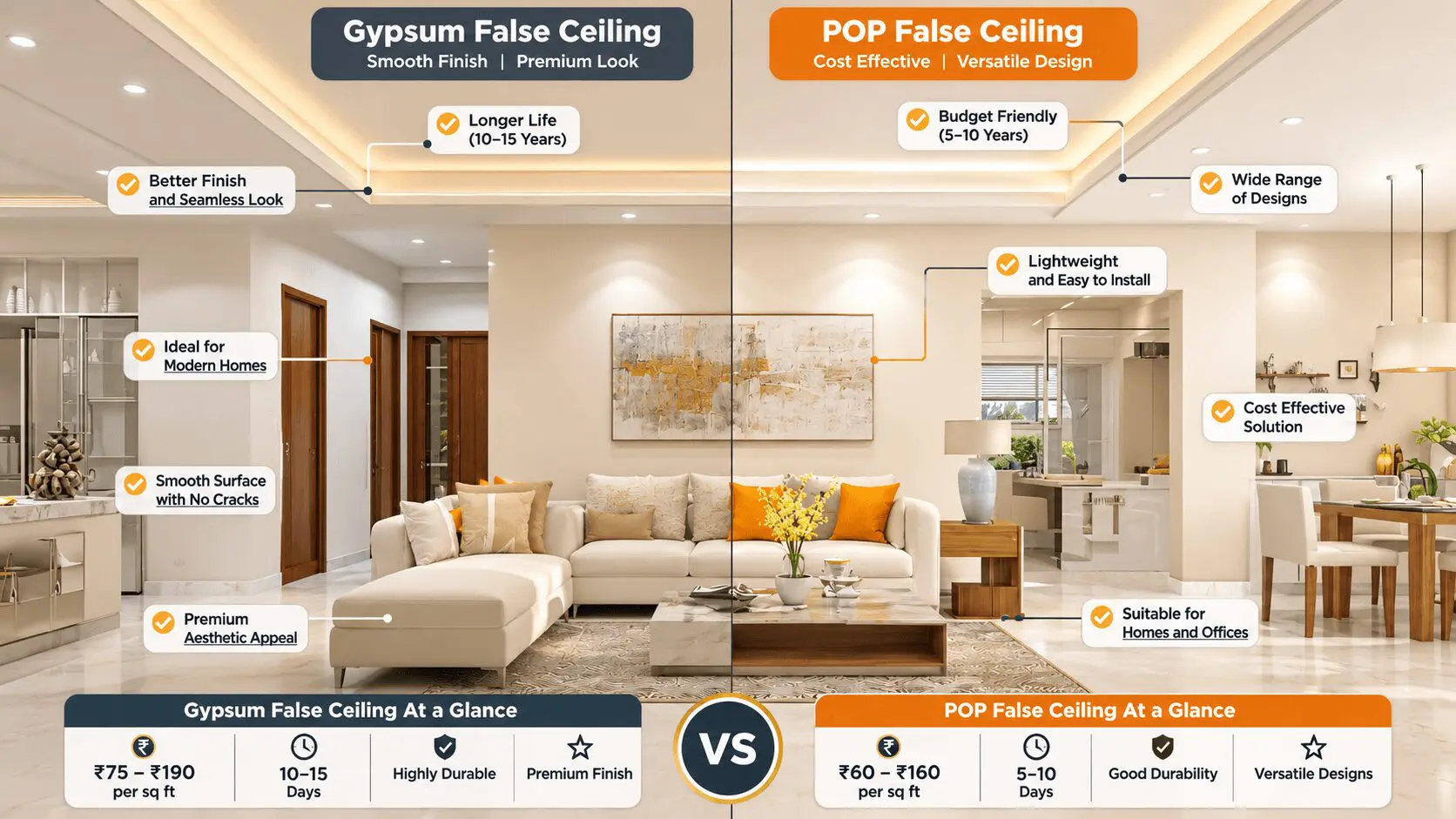
| Decision factor | Gypsum board ceiling | POP ceiling |
| Basic form | Factory-made panels fixed to a suspended frame | Powder mixed with water and shaped or applied on site |
| Construction method | Mostly dry construction with jointing and finishing | Wet process requiring mixing, application and setting |
| Design character | Best for planes, trays, coves, geometric layers and broad curves | Best for tight curves, mouldings, cornices and sculpted details |
| Finish control | Consistent panel surface; joint quality remains critical | Can look seamless, but surface quality depends strongly on the artisan |
| Installation speed | Usually faster after the design and services are frozen | Usually slower and messier because more work happens on site |
| Crack pattern | Cracks may appear at joints, corners or moving interfaces | Shrinkage or movement cracks may appear in applied or moulded work |
| Repair | Damaged areas can be cut and patched, with joints refinished | Local patching and remoulding are possible with matching skill |
| Specification | Board, channel, hanger, screw and compound can be documented | Mix, reinforcement and workmanship are harder to standardize |
Advantages of Gypsum Board
Gypsum board offers a controlled, factory-made surface and a defined installation sequence. Straight edges, measured framework and repeatable panels help produce crisp trays, perimeter drops and shadow details. Because most material arrives ready to fix, site mixing, water use, debris and drying time are generally lower than with extensive POP work.
- Faster execution: broad ceiling areas can be closed quickly once the framework, services and levels are approved.
- Consistent finish: factory panels simplify level control, although correct taping and jointing are still essential.
- Cleaner site: cutting and joint finishing create dust, but the process uses less wet plaster across the full ceiling.
- Clear specification: board type, thickness, channel system, hanger spacing, screws and compound can be written into the quotation.
- Specialized options: moisture-resistant, fire-performance and acoustic boards or systems are available for defined applications.
- Easy geometric design: flat planes, perimeter coves, trays, islands and linear modern forms are efficient to set out.
Advantages of POP
POP excels when the ceiling depends on hand-shaped detail. It can be cast or worked into profiles, medallions, cornices, waves and transitions that would require special flexible boards or multiple cut pieces in a dry-construction system. A skilled artisan can also blend repairs and decorative features without leaving an obvious sheet layout.
- High design freedom: tight curves, mouldings and ornamental details can be formed to match a traditional or statement interior.
- Seamless visual effect: applied work can avoid the repeated panel geometry associated with boards.
- Useful for selective detailing: POP is efficient for cornices, ceiling roses, edge profiles and localized curved features.
- Local repair potential: an experienced craftsperson can reproduce or patch decorative forms when the original profile is understood.
- Flexible finishing: the completed surface can be primed and painted to coordinate with walls, lighting and the overall interior palette.
Gypsum Board vs POP: Which Is Better for Your Home?
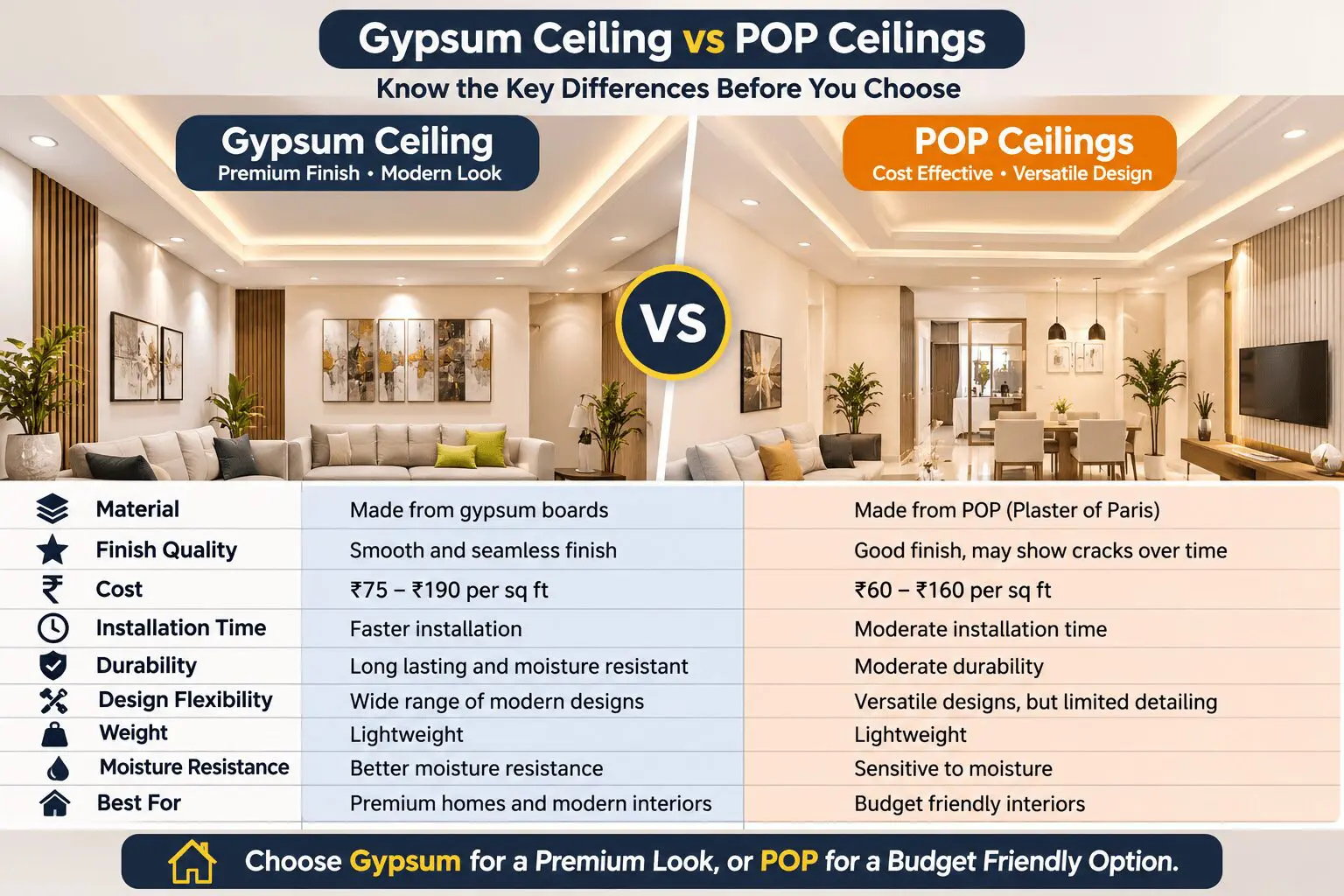
For most modern homes, gypsum board is the better default for the main false-ceiling area. It suits apartment schedules, clean geometric design and coordinated lighting. POP becomes the better choice when a specific decorative feature cannot be achieved efficiently with boards. A hybrid often prevents the homeowner from paying for handcrafted POP across a large plain area that gypsum board can execute more predictably.
| Room or requirement | Better starting choice | Reason and caution |
| Living room with cove lighting | Gypsum or hybrid | Clean levels and fast coverage; use POP only for curves or decorative profiles |
| Bedroom with simple perimeter drop | Gypsum board | Quiet modern finish with limited site disruption |
| Traditional hall with cornices or ceiling rose | POP or hybrid | Better shaping freedom; verify artisan skill and reinforcement |
| Compact room with low height | No full ceiling or slim perimeter | Preserve clear height regardless of material |
| Kitchen | Specified moisture-appropriate system | Coordinate chimney duct, heat, cleaning and inspection access |
| Bathroom or balcony | Usually avoid standard POP and standard gypsum | Repair waterproofing first; select a wet-area-rated system |
| Leak-prone top floor | Postpone installation | No finish material compensates for unresolved slab or plumbing leakage |
Lucknow hot summers, monsoon humidity and dust do not automatically disqualify either material. The larger risks are roof or plumbing leakage, condensation around AC lines, damp external walls and poor ventilation. Repair the moisture source before closing the ceiling. A moisture-resistant gypsum board tolerates humidity better than a standard board, but it is not waterproof and should not conceal an active leak.
Read also: False Ceiling Designs That Elevate Home Interiors
Gypsum Ceiling vs POP Ceilings: Quick Info
| If your priority is… | Usually choose… | Verify before approval |
| Fast, clean installation | Gypsum board | Framework layout, board type, service readiness and joint system |
| Minimal modern design | Gypsum board | Finished height, straightness, shadow gaps and lighting alignment |
| Curves and ornamentation | POP or hybrid | Scaled profile, sample, reinforcement and skilled installer |
| Lower starting rate | Compare both | Full inclusions; a low rate may omit paint, electrical or complex drops |
| Better moisture response | Neither standard system | Leak repair and a product explicitly suitable for the exposure |
| Documented performance | Specified gypsum system | Complete manufacturer system, not a generic board claim |
| Best all-round result | Hybrid | Clear interface between the gypsum installer and POP artisan |
Neither material should carry an unsupported promise of being crack-proof, waterproof, soundproof or fire-rated. Ceilings can be designed for specific performance only when the complete tested or manufacturer-specified assembly is followed. Ask for product names, drawings and installation details rather than accepting a colour-coded board or verbal claim.
Cost Comparison Between Gypsum and POP False Ceilings
Current Lucknow planning bands vary more by design than the material name alone. A basic flat POP ceiling may start around ₹60-₹85 per sq ft; a POP border may be about ₹85-₹120; and POP with cove lighting provisions or multiple levels may reach ₹120-₹180. A flat gypsum-board ceiling is commonly budgeted around ₹75-₹130 per sq ft. Premium channels, specialist boards, shadow profiles, deep drops and small work quantities can take a gypsum design above that band. These July 2026 figures are budgeting allowances, not Lucknow Interio package prices or contractor commitments.
| Scope | Lucknow planning band | What changes the rate |
| Basic flat POP | ₹60-₹85 per sq ft | Area, mesh or frame, thickness, leveling and finish |
| POP border design | ₹85-₹120 per sq ft | Border width, profile, curves, labour and running-foot details |
| POP cove or multi-level design | ₹120-₹180 per sq ft | Drops, curves, templates, lighting provision and complexity |
| Flat gypsum-board ceiling | ₹75-₹130 per sq ft | Board and channel grade, framework spacing, height and joint system |
| Electrical, fixtures and painting | Often separate | Points, wiring, LED profiles, drivers, fixtures, primer and paint |
For illustration, 120 sq ft of basic flat coverage gives roughly ₹7,200-₹10,200 for POP and ₹9,000-₹15,600 for gypsum before excluded items. A quotation can rise materially when it adds a cove measured in running feet, multiple levels, light cut-outs, access panels, painting, scaffolding, wiring, fixtures, fan reinforcement, transport, debris removal, taxes or repairs to the original slab.
Compare quotations line by line. For gypsum, record the board brand, type and thickness; channel manufacturer and section; hanger and framework spacing; screws; joint tape; compound; primer; paint; access panels and independent fixture supports. For POP, record the supporting framework or mesh, reinforcement method, intended thickness, moulding profile, number of coats, surface finish, drying or setting allowance, primer, paint and responsibility for cracks.
Read also: Modular vs Custom Interiors: What Works Best for Lucknow Homes
Durability, Cracking and Maintenance
Cracks usually reveal movement or execution problems rather than a simple material verdict. Gypsum boards commonly crack at joints, corners or the meeting point with another surface when the framework moves, joints are poorly treated or the perimeter lacks the correct detail. POP may crack because of shrinkage, excessive thickness, weak reinforcement, hurried application or movement in the support.
Inspect the slab and services before closure, photograph the concealed framework and keep access to drivers, junctions, valves and AC connections. Repair leaks immediately. Do not overload the suspended ceiling, and do not allow future electricians to cut framing members or hang fixtures casually. After any patch, prime the repaired area and repaint a logical ceiling plane to reduce visible colour variation.
Seven Checks Before You Approve the Ceiling
- Measure the room and confirm the finished clear height, drops, curtain channels, wardrobe clearance, doors and AC positions.
- Freeze a reflected ceiling plan showing levels, fan centres, lights, coves, access panels, detectors, speakers and switch groups.
- Repair slab, roof, plumbing and AC-condensate leaks before any framework or decorative work begins.
- Ask for a complete material and system specification, including framework, reinforcement, board or POP details, joints and paint.
- Provide independent slab support for fans, chandeliers, ducts and other heavy or vibrating loads.
- Compare quotations using the same drawing, coverage, inclusions, electrical scope, paint, taxes, warranty and repair responsibility.
- Inspect a sample or completed project for straightness, joint visibility, curve accuracy, lighting alignment and crack history.
Final Recommendation
If your home needs a simple tray, perimeter cove, island or modern geometric ceiling, choose a properly specified gypsum-board system. If the design depends on classical cornices, sculpted motifs or tight organic curves, use POP selectively with a proven artisan. Avoid choosing only by the lowest rate: the hidden framework, moisture condition, electrical coordination and joint workmanship determine whether the ceiling still looks good after the first monsoon.
Lucknow Interio can review your room height, lighting needs, slab condition and design style, then prepare a coordinated ceiling plan and like-for-like material quotation as part of practical interior design in Lucknow.
Request a consultation and customized quotation: 8800127922 | contact@lucknowinterio.com