
When planning a new office, businesses usually face two delivery choices. They can appoint one turnkey company to manage design and execution, or hire designers, carpenters, electricians, painters and other contractors separately. Both approaches can produce a good office, but they demand very different levels of time, documentation and owner involvement.
The phrase “manual contractors” is not a formal industry term. In this guide, it means an owner-managed model in which the business appoints and coordinates individual contractors or vendors. Before selecting an Office Interior Designer in Lucknow, understand how responsibility, cost control, quality and changes will work under each model.
| Quick answer Choose turnkey delivery when you need one coordinated team, limited owner involvement and a complete design-to-handover scope. Choose an owner-managed contractor model when the design is already complete, the work is simple and your team has time and technical ability to coordinate trades. The contract, drawings and bill of quantities matter more than the label. |
What Is Turnkey Office Interior Design?
Turnkey Office Interior Design places planning, design documentation, material selection, procurement, vendor coordination, execution, supervision and handover under one main provider. The client supplies the requirements, budget and approvals; the provider coordinates the project according to the agreed scope.
Turnkey does not automatically mean every item is included or the price can never change. The agreement must state inclusions, exclusions, material specifications, taxes, approvals, change procedures, payment milestones, warranty and responsibility for specialist systems.
What Is the Owner-Managed Contractor Model?
In the owner-managed model, the business hires one or more contractors and coordinates them directly. A designer may prepare the layout and drawings separately, or the owner may provide a basic brief. The business then manages pricing, work sequencing, site access, material approvals, quality checks and payments across multiple parties.
This approach can work well when the project is small, drawings are complete and the owner has reliable vendors or an internal project manager. It can become difficult when responsibilities overlap—for example, when furniture installation depends on electrical points that have not been finalized.
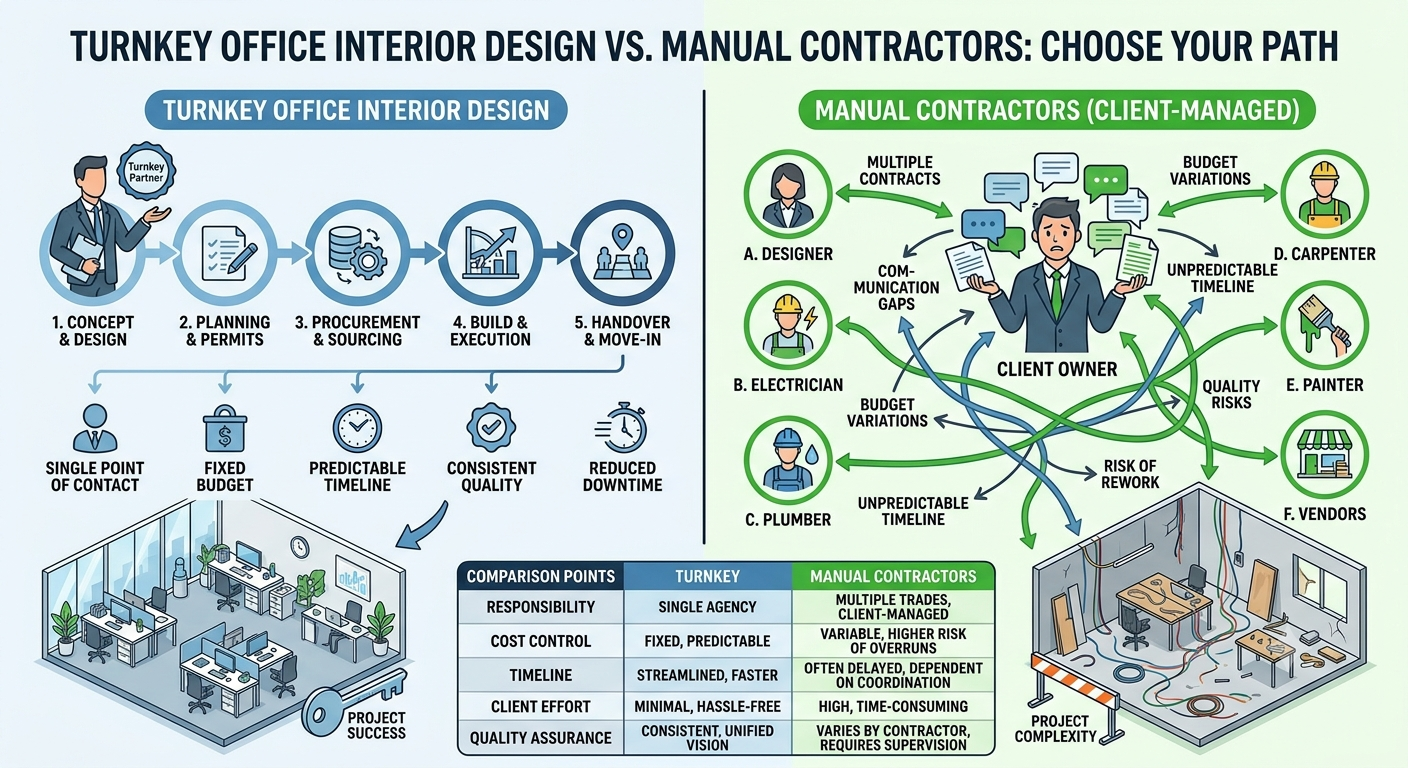
Turnkey Office Interior Design vs Manual Contractors
| Decision factor | Turnkey model | Owner-managed contractors |
| Responsibility | One main provider coordinates the agreed scope | Owner coordinates separate designers, trades and suppliers |
| Design integration | Design and execution are planned together | Depends on quality and completeness of external drawings |
| Owner time | Lower day-to-day coordination when the provider performs | Higher involvement in follow-ups, sequencing and decisions |
| Cost visibility | Can use one consolidated BOQ and variation process | Requires comparison and reconciliation of multiple quotations |
| Flexibility | Changes follow the main provider’s process | Owner can replace or negotiate with individual vendors |
| Quality control | Managed under one supervision structure if contracted | Owner or appointed consultant must inspect each trade |
| Accountability | Clearer when interfaces are included in one contract | Disputes may arise at the boundaries between contractors |
| Best suited to | Complete, time-sensitive or technically coordinated offices | Simple work with complete drawings and capable owner supervision |
1. Planning and Design Quality
Office projects require more coordination than choosing colours and furniture. Workstations must align with electrical and data points; cabins affect lighting and ventilation; meeting rooms need acoustic, display and cable planning. Under a turnkey model, one team can coordinate these elements before execution.
With individual contractors, the result depends heavily on the design package. If contractors are working from reference images or verbal instructions, they may make different assumptions. The owner-managed model becomes much stronger when a professional layout, electrical plan, ceiling plan, furniture drawings, finish schedule and bill of quantities are issued before quotations.
2. Budget and Price Comparison
A contractor-only quotation can look cheaper because it may cover only labour and selected materials. A turnkey quotation may also include design, project coordination, procurement, supervision and handover. Comparing the totals without comparing scope can therefore be misleading.
Lucknow Interio current published guidance places office interiors broadly from ₹800–₹1,800 per sq. ft. depending on scope and materials, while a separate turnkey guide uses higher ranges for more comprehensive specifications. These figures are indicative and should not be used as quotations. Ask each bidder to price the same drawings, quantities and material standards.
| Cost item | Turnkey quotation | Owner-managed model |
| Design and drawings | May be included or separately identified | Usually appointed and paid separately |
| Trade coordination | Normally included within project management | Handled by the owner or paid consultant |
| Materials and procurement | Specified and consolidated under agreed scope | Purchased across separate contractors and suppliers |
| Changes | Recorded as variations under one process | Must be tracked across affected vendors |
| Owner’s time | Usually lower but still requires approvals | Often substantial and rarely shown as a project cost |
Hidden Costs to Check in Both Models
- Design revisions and drawings beyond the agreed deliverables.
- Demolition, debris removal, loading restrictions and after-hours work.
- Electrical upgrades, data cabling, HVAC changes and fire-safety systems.
- Transport, storage, protection of completed work and final cleaning.
- Taxes, approvals, landlord deposits and specialist consultant fees.
- Rework caused by late decisions, incomplete drawings or changed materials.
- Temporary office arrangements and business disruption during renovation.
Read also: Turnkey Interior Design Services Explained
3. Timeline and Coordination
Turnkey delivery can simplify sequencing because one provider coordinates drawings, procurement and site trades. That does not guarantee a short timeline: client approvals, imported products, custom furniture, landlord permissions and hidden site conditions can still delay work.
With separate contractors, the owner must build and maintain the schedule. Electrical work may need to finish before ceilings close; flooring may need protection before furniture installation; networking and security teams may depend on completed cable routes. A delay by one contractor can affect several others.
4. Quality Control and Accountability
A turnkey provider offers a single escalation point only for items included in its contract. The client should still review drawings, samples, mock-ups and progress at defined milestones. Clear inspection and snagging procedures are more dependable than verbal assurances.
Independent contractors can deliver excellent quality when their roles are clearly defined and inspected. The risk appears at interfaces. If a glass partition clashes with the ceiling or furniture blocks a power point, each vendor may say another party caused the issue. Complete drawings and written responsibility reduce this problem.
Read also: Interior Designer vs Contractor
5. Control and Flexibility
The owner-managed route gives businesses direct control over vendor selection and individual negotiations. It may also make it easier to phase work or retain trusted contractors. However, every saving or change must be evaluated for its impact on other trades.
Turnkey projects concentrate coordination but require the client to approve the provider’s process, vendors and commercial terms. Review whether alternative materials are permitted, how substitutions are approved and what happens when the client changes the layout after work has started.
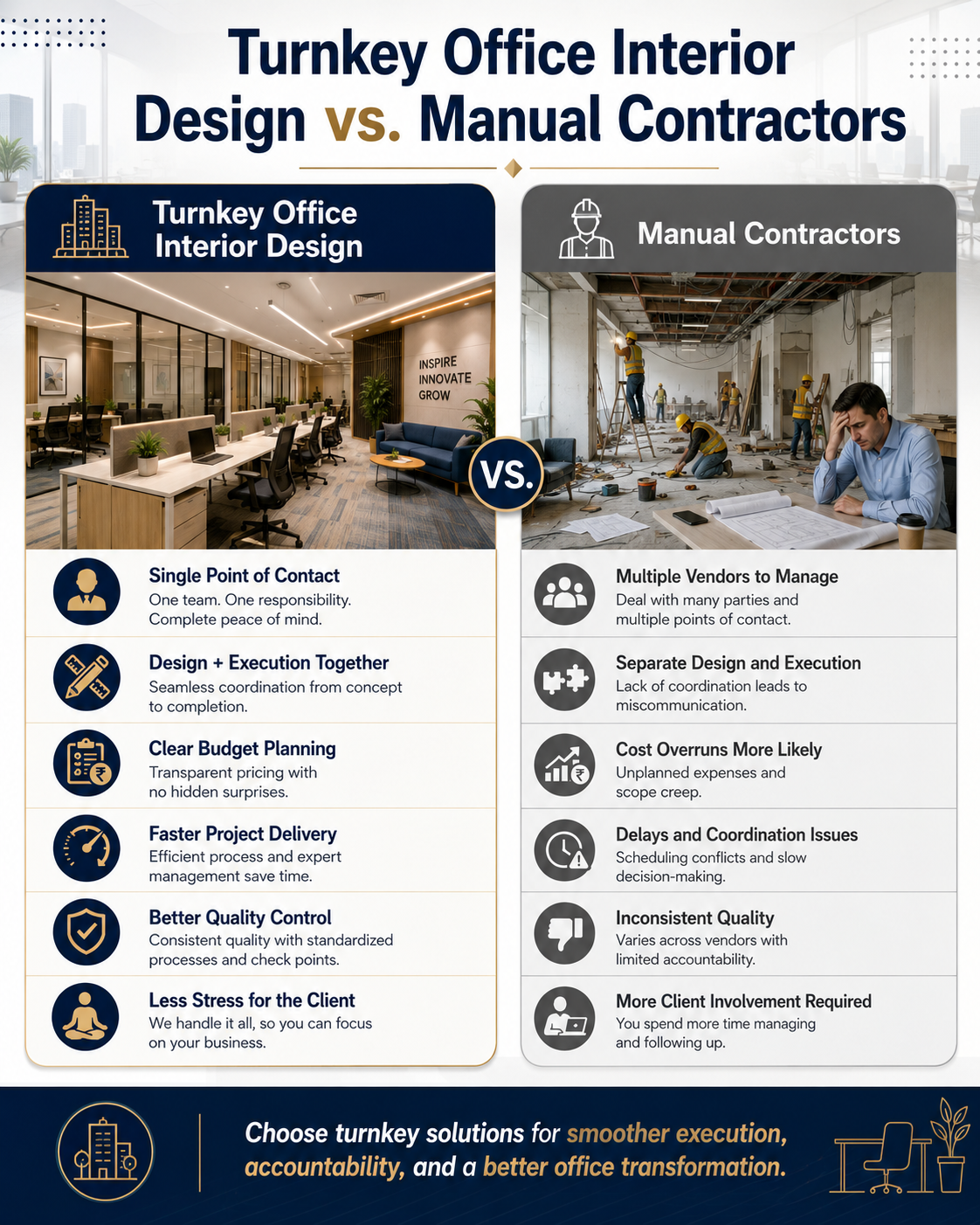
When Turnkey Office Interior Design Is the Better Choice
- Your office requires coordinated civil, electrical, networking, furniture and branding work.
- The business team cannot supervise multiple vendors every day.
- A fixed opening or relocation date makes sequencing important.
- You want one consolidated scope, payment schedule and handover process.
- The space needs detailed planning for employees, clients and future growth.
- The project is in an occupied office and requires phased execution.
When Separate Contractors May Be Practical
- The work is limited to painting, furniture replacement or a clearly defined upgrade.
- Complete execution drawings and specifications are already available.
- You have reliable contractors who have worked together successfully.
- An internal project manager or independent designer can coordinate and inspect work.
- The project will be completed in controlled phases with clear interfaces.
- Direct purchasing and vendor management are important business priorities.
The Hybrid Model: Designer-Led, Contractor-Executed
Businesses do not always need to choose between two extremes. In a hybrid model, an Office Interior Designer in Lucknow prepares the layout, drawings, specifications and bill of quantities, while contractors execute under owner or designer supervision. This preserves competitive tendering while retaining professional coordination.
The hybrid model works best when supervision frequency, approval authority, contractor responsibilities and payment certification are written into the appointment. Without this, the designer may be expected to solve site issues that were not included in the design fee.
Questions to Ask Before Signing
| Question | Why it matters |
| Who owns design coordination? | Clarifies responsibility for clashes between furniture, electrical, ceiling and services |
| Is there an approved BOQ? | Allows comparable pricing and control of additions |
| Which items are excluded? | Reveals specialist work, taxes and owner-supplied products |
| How are changes approved? | Prevents verbal variations and unexpected bills |
| What are the milestones? | Links payments to measurable design, procurement and site progress |
| Who inspects quality? | Defines samples, mock-ups, stage checks and final snagging |
| What support follows handover? | Clarifies warranties, defects and response responsibilities |
Decision Checklist
- Define the office area, headcount, zones, equipment and opening date.
- Decide how much daily project coordination your team can realistically provide.
- Prepare drawings and a common BOQ before comparing quotations.
- Check design, execution, procurement and supervision inclusions separately.
- Review material brands, thicknesses, finishes, samples and warranties.
- Identify landlord, building, safety and specialist-system responsibilities.
- Compare the full delivered cost, not only the lowest initial quotation.
- Record approvals, variations, payment milestones and completion criteria.
- Review relevant office projects and speak with recent commercial clients.
- Keep a contingency for approved changes and hidden site conditions.
Read also: Interior Design Cost in Lucknow
Choose the Right Office Delivery Model
The right choice depends on project complexity, available management time, documentation and the level of coordination required. A well-documented owner-managed project can succeed, and a poorly defined turnkey contract can still create disputes. Begin with the scope, then choose the delivery model that assigns responsibility most clearly.
Lucknow Interio can help assess your office, prepare a practical plan and provide a customized scope based on your requirements, timeline and expected investment.
Call 8800127922 or email contact@lucknowinterio.com to request an office site consultation and customized quotation for Office Interior Design in Lucknow.
Frequently Asked Questions
Is turnkey office interior design more expensive than hiring contractors?
A turnkey quotation may appear higher because it can include design, coordination, procurement and supervision that contractor-only quotations exclude. Compare identical drawings, quantities, materials and deliverables. The lowest initial quotation is not necessarily the lowest completed project cost.
What are manual contractors in office interior work?
“Manual contractors” is an informal term for an owner-managed approach involving separate contractors or vendors. The business coordinates design, carpentry, electrical, painting, flooring and other trades directly. It can work well when drawings are complete and capable project supervision is available.
Which option gives the business more control?
Separate contracting gives direct control over vendor appointments and individual negotiations, but requires more coordination. Turnkey delivery centralizes responsibility but operates through one provider’s processes and commercial terms. In either model, drawings, specifications and written approval of changes protect the client’s control.
Can I hire a designer and contractors separately?
Yes. In a hybrid model, the designer prepares layouts, drawings, specifications and a bill of quantities, while contractors execute the work. Define the designer’s supervision role, contractor responsibilities, approval authority and payment-certification process before execution begins.
How do I compare turnkey and contractor quotations?
Issue the same drawings, BOQ, material specifications and timeline to every bidder. Compare design fees, supervision, procurement, electrical work, furniture, transport, taxes, exclusions, warranty and change procedures. Clarify whether quoted rates apply to carpet area, built-up area or measured quantities.
When should a startup choose turnkey office interiors?
Turnkey delivery may suit a startup with a fixed opening date, limited management time and a project involving multiple trades. A small cosmetic refresh may not require it. Decide based on scope complexity, internal coordination capacity, documentation and total delivered cost.
How do I select an Office Interior Designer in Lucknow?
Review relevant commercial work, confirm the design and execution team, inspect specifications and samples, request an itemized BOQ, understand exclusions and check the change-order process. Ask who will supervise the site, coordinate specialists, certify completion and handle defects after handover.